Last walk down the Ramblas and visit to La Boqueria Yesterday I took my final walk down the rambles to check out the Mercat St. Josep (a.k.a. La Boqueria). This market was first opened in the early 13th century and primarily sold meat. Today, however, the market sells just about everything. Strolling through it I saw fish, fruits, vegetables, pastas, wine, cheese, eggs, and meat of all kinds.
My Brazilian grandma would love this salted codfish Here are some Croquetes which remind me of my grandma. She made the best ones.
There are also small bars where visitors can eat and drink with the larger bars actually having tables on the perimeter of the market, which is essentially the size of a medium-sized block. When I come back and spend more time here (and when my Spanish is a little stronger) I would like to ask some of the vendors about their perspective of the market and how it has changed in their lifetime.
On the way down to La Boqueria, I took a few pictures on Las Ramblas. I caught a photo of illegal street vendors selling bootleg items.
a paranoid seller
These guys open up their sheets and sell items for as long as they can before the police pass by. When the police come, they make a Santa Claus escape by grabbing the four corners of their sheets and running off with what looks like a large, white sack. It would be cool to get the police’s perspective on these characters.
Although too touristy for my tastes, the Ramblas has street performers which are entertaining to watch and imagine what they must be thinking day to day.
what's the shelf-life of a street performer?
As one makes his way down the Ramblas, there are definitely genres of merchants clustered together. I am not sure the meaning of this - seems like it would promote unwanted competition. First there are clusters of pet stores then flower shops and then (expensive) tapas restaurants.
pet shops on Las Rambles (above); flower shops (below)
The Cathedral The next stop was the city’s old Cathedral, which seems to be essentially dedicated to a young girl named Eulalia (Barcelona’s patron saint) who was tortured and crucified by the Romans at the age of 13 for her faith. Her body remains in an elaborately decorated sarcophagus below the high altar of the church shown below.
Old mixed with modern conveniences
Carvings in the Cathedral
I also got a chance to go up to the roof of the Cathedral and check out the views from above. There also seems to be a lot of construction and renovation going on.
The roof of the cathedral overlooking the mess of the old city
Replacement of the old roof with newer material
Celebrity shot: Rick Steves taking pictures for his new guide.
Museu d’História de la Ciutat The final stop of the day was my favorite - the Museu d’História de la Ciutat (City History Museum). The tour started with an elevator, which descended to ruins discovered under the street level, some of which appear to be still in the process of excavation.
outside of the city museum, which consists of multiple levels - the lowest ones dating back to 14 B.C.
I wasn't allowed to bring my camera into the museum but I recorded some interesting facts:
Interesting fact 1: The Domus The wealthiest homes in the city (those of nobles) were called “Domus(es)” – which is a closed, inward-facing home. These homes were built with an Atrium and the Peristylum (garden), both that were open to the sky and contained inward slanting roofs to collect rainwater.
Interesting fact 2: Urine, ash, and lime to wash clothes Laundry facilities in ancient Barcelona were influenced by the Romans. Outside the clothes washing facility would be a place where locals were encouraged to urinate. Urine was combined with lime and allowed to decompose to form ammonia (bleach). This was used with ash to clean clothes.
Interesting fact 3: Fish cleaning and processing facilities Similar to laundry facilities, fish would be processed (chopped and washed) in their own facility. Fish blood and intestines were placed into a vessels called maceration tanks and allowed to ferment for 2-3 months. The product was called garum, which was a tasty, very expensive sauce enjoyed by the wealthy. Sounds pretty gross to me.
Interesting fact 4: ½ to ¾ liters per day! Wine making was a huge deal here in and adults and children consumed it in large quantities (½ to ¾ liter per person per day). It was thought to have medicinal properties so I guess that made it all the more acceptable to drink. Much of the ruins unearthed (600 sq. meters), which were included in the museum, were that of wine making and storing facility.
On Friday Kirsten left me for the United States – a sad day for me.I wanted to fly home with her since the program was canceled but couldn’t find a reasonable price on a ticket; peak vacation time creates the lack of coach seats immediately available.So prices are better for Monday or Tuesday of next week.If I flew out earlier, I would have paid nearly $1,650 one way.
So, I decided to stay in Barcelona for 4 nights at the cheapest, reasonable hotel I could find: The Heperia Fira Suites which was $64/night located near the second to the last stop on the L1 metro.This is about a 15-minute ride into the heart of the tourist district (The Ramblas).In short, the place is like a little one room apartment in Manhattan, with a separate bedroom and bathroom and one larger room containing the kitchen and living room.The shower is super fancy with multiple sprayers coming out of the wall. The hotel's location is strange, though; it's located in a working-class neighborhood.
The living room
Bathroom - wow. I dig the multiple shower heads
Balcony - Pretty cool... but it does look over the front walking space of a large
electronics store (like Best Buy).
I am staying right under the Large "M" in the "Media" sign on the roof.
The neighborhood - boring but quaint, practical and safe
And a boring but practical dinner - Ravioli with veggies and meatballs.
Wasn't I eating out last week? What the $%&* happened here?
What's that above the fruit shop?
Staying on the edge of town, which has allowed me to see what life is like outside of the rich, tourist-infested center of Barcelona.Here are some observations (some of which parallel those I have noticed between different socioeconomic areas in Manhattan):
First: gone are the small apartment buildings with cute balconies and windows.Apartment buildings here have an industrial look and feel to them that suggests utility is the number one concern.
typical residences in this area. Reminds me of the projects in Manhattan but this area feels safe
Living institutionalized
Second:In the city center there are many fit, young men and women walking around in stylish clothes.Here, there are mainly older people and families.Lots of children fill the open park spaces on the weekend and men frequent the “real” tapas bars at night.Also, over-weight people are more prevalent here.
Third: No clubs, fancy restaurants, or neat shops.Grocery stores, bakeries, odds and ends shops, working class tapas bars, and schools make up what is around here.This place is really community focused, not tourist-focused.
Friday Morning: retired men playing in the park
Saturday fun: A family picnic in the park - roped off to create sense of cozy party space?
One other family did this roping off thing as well; wish I were invited
The community feel, makes this place feel safer.I heard families outside of my apartment with small children playing until 12:30am.Otherwise, it’s quiet.
[Kirsten]
We decided we’d squeeze one last activity out of our stay in the city before heading to the beach in Sitges. It seemed simple enough to us – we’ll wake up relatively early (just so you all know, we are living on Barcelona time now, which means our days really get going around 10am and wind down around 2am – quite a change from our normal 6am – 10pm, eh?), grab some café and head over. Well. Nothing ever quite works out how you imagine it when you’re traveling. We forgot (whoops!) that we had to pack, and check out, and think about what we were going to do for lunch after the museum, and think about the train schedules for travel to Sitges, etc., etc. THEN we realized we would have to walk a good chunk of the way to the museum up a gigantic hill.
On the way up to Joan Miro's Fundacio - a view from the Catalan Museum of Art
So, when we finally arrived at the museum, it was well into the early afternoon hours. I couldn’t help but think about all the beach time I was missing.
[Brian]Yes, she wanted to get to the Joan Miro museum as quickly as possible – I knew I couldn’t convince her to walk a couple metro stops. However, once at the museum, both of us savored and meditated on the art inside and the rush went out of style for around 2.5 hours.
So, Joan Miró (1893-1983)...
This man was not only a painter and sculptor but a ceramist.He is, perhaps, the biggest rebel artist of his time.He tried his best to “assassinate” what he considered conventional methods in established painting, which supported pleasurable visual elements and balance as well as the established form of cubism (mastered by Picasso in the latter part of his career).He considered the stiff, structured, defined artistic methods to perpetuate and promote the propaganda and cultural identity of the wealthy.So, Miró was actually laying the hammer down on Picasso’s art form, as well. So I guess Cubism was cool when Picasso discovered it but once it was established (about the time when Miro came around) it became lame (to Miro, at least).
Views from the roof of Joan Miro Museum were easing. The museum sits close to the Olympic stadium in Montjuic. Brian is thinking,"Both Miro and Picasso lived to over 90 years (Picasso: 92 and Miro:100). Is there a medical study on this? Maybe I should drop the bike and pick up paint brushes"
[Kirsten]
Once inside, though, all thoughts of that order vanished. The museum was incredible. Although she looks bored here, Kirst is actually having a great time.
We are a little tired, though, and beach time is needed
Unbeknownst to me at the time of my entry into that building, I am actually a fan of abstract art. I’m not sure if you are all familiar with Joan Miro’s work, but I’m sure you’d recognize it immediately if you saw it – lots of bright, primary colors and thick lines used to draw shape. Thank goodness we had an audio guide, because otherwise his pictures might not have made sense. However, with the guide, we were able to make some sense of what we were looking at and it became….quite fun. In the words of Rick Steves…. ‘Miro believed that everything in the cosmos is linked – colors, sky, stars, love, time, music, dogs, men, women, dirt, and the void. He mixed childlike symbols of these things creatively, as a poet uses words. It’s as liberating for the visual artist to be abstract as it is for the poet….Miro would listen to music and paint. It’s interactive, free interpretation. He said, ‘for me, simplicity is freedom’. What a cool guy. He painted lots of pictures of women and stars especially, often on the same canvas – they always looked different, but the themes and messages were always similar.
[Brian] I won’t lie. Most of this work went over my head. Thank God for the 4 euro audio cliff notes guide. I was so dependent on the explanations that I wouldn’t study a work without them; I knew this isn’t what a true connoisseur of fine art would do but that’s why I am not one. One of Miro’s works consisted of three huge canvases (so big they needed their own room), each with a free-handed, non-connecting, single line running across them... and nothing else. This is art? No, I think this is what happens when an artist is so respected that he can get away with anything he claims he spent years trying to conceive; anything is often accepted and accommodated for such people. Much of his stuff, however, is quite decent but for a few of his works, even he must have been quietly laughing after selling them.
[Kirsten]
We weren’t able to take pictures inside the museum, but there was a rooftop exhibition of some of his sculptures and we snapped some photos there. As I mentioned before, the building WAS located on the top of a hill, so we had great views of Barcelona behind us.
Okay, after the museum we hustled back down the hill (I was starving, and we really did hustle), headed back to our hotel via subway, made a quick stop at the grocery store for bocadillo ingredients, grabbed our suitcases, bought tickets for the next train to Sitges, and ran down the ramp and just barely made the train. We were proud of ourselves but somewhat exhausted and as I mentioned before, starving.
So, from the grocery store we had bought bread (a long baguette) and cheese. There were basically three problems: the bread was, obviously, in one long, continuous piece and it was extremely crumbly; third, we were on a crowded European train, which means you always sit facing the people seated directly behind or in front of you (it makes for a lot of awkward knee and foot touching). There was a kind old man across from Brian and a mom across from me (her daughter sat next to me). In order not to cause crumbs to fly every which way like sparks from a from a crackling fire, Brian devised a plan: cut the bread over – and semi-inside – his backpack. What a genius – no crumbs flew anywhere, except directly into his backpack. He created our cheese bocadillos and we ate them like there was no tomorrow. We felt better right then and there.
Sitges [Kirsten]
We felt even better when we began to see the beautiful Mediterranean Sea. Man, it’s like a jewel – layers of blue and green upon other layers of blue and green. We hopped a bus which drove us almost to the door of our hotel.
After we checked in and had our first glimpse of our hotel room (during which our jaws literally dropped, this place is soooo nice!) we took a few minutes to get to know the space. The room is beautiful, and we are completely self-sufficient in here – we have a kitchenette, a washing machine (!), a really, really big balcony, and the most comfortable bed perhaps in all of Spain. We absolutely LOVE it here and are enjoying every second!
the view from our balcony in Sitges
[Brian] The Hotel Sunway Playa Golf was about US$105 per night and it was worth it. It is not only new but it’s well designed and well managed. Our apartment had a laundry washing machine, and a drying rack, which we could place on our balcony. They also provided us with dishes, knives, cutting boards, etc. and the means to clean them. This allowed us to cook our own food, cut a variety of fresh fruit, which saved us a lot of money on eating out, since restaurants in this area are pricey.
Dinner in at our place (complete with ice cold Estrella Spanish beer)
We also got bikes (and locks) with our room which made up for the 1 mile distance the hotel was from the town’s center.
Kirsten mastering clothes washing... Euro-style
Heavy chill-time
first stroll through the town's center
Sitges is probably one of the most gay friendly towns I have ever been. Walking through the town's center, shown above, there were more same-sex couples than hetersexual ones.
International Study Program Last Minute Cancellation
I got bad news from the program director of the international education program I was supposed to start working for this summer. Due to some last minute key staff pull out, the program was canceled. This means that I’ll be heading home much earlier than I thought. Kirsten and I were having such a great time in Sitges, we decided to stay here for another night, for a total of 3 nights. Although I am bummed about not being able to work here and continue my learning process of running international education programs, I am glad to return back to NYC, spend time with Kirsten and work on my proposal.
Brian Gabele is a Ph.D. Student at Teachers College specializing in Economics of Education. His professional career goal is to direct programs that serve to increase the cultural awareness of as many Americans as possible through study abroad experiences. Brian has lived and worked in Nepal and Brazil and is currently living in NYC. In his free time he enjoys competitive cycling and currently rides for Columbia University and Luzzo's (formally Southafrica.net).


 My Brazilian grandma would love this salted codfish
 a paranoid seller
 what's the shelf-life of a street performer?
 pet shops on Las Rambles (above); flower shops (below)


 Carvings in the Cathedral
 Carvings in the Cathedral
 Replacement of the old roof with newer material
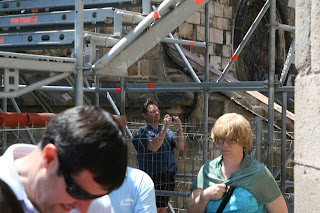 Celebrity shot: Rick Steves taking pictures for his new guide.
 Replacement of the old roof with newer material
 Celebrity shot: Rick Steves taking pictures for his new guide.
 The final stop of the day was my favorite - the Museu d’História de la Ciutat (City History Museum). The tour started with an elevator, which descended to ruins discovered under the street level, some of which appear to be still in the process of excavation.
 outside of the city museum, which consists of multiple levels - the lowest ones dating back to 14 B.C.


